











More information coming soon ... Read the article about this home's backyard from Phoenix Home and Garden!
It's no secret that scant rainfall is the Sonoran desert’s defining characteristic. Although annual precipitation in Casa Grande, Arizona is just a smidgen over 9 inches, Robin and Bryan Bukovina’s smartly reconfigured backyard deploys every drop of rain. The result of their planning and fine-tuning is a sustainable landscape that maintains its allure even during times of drought.
Harvesting Rainwater
"Our backyard, which is lower than surrounding properties, flooded during the first hard rain we experienced," Bryan recalls. Rather than shunting the water into storm drain systems – as is the typical solution in most developments – the couple took the flooding as a golden opportunity to create a naturalistic landscape without wasting precious potable water resources.
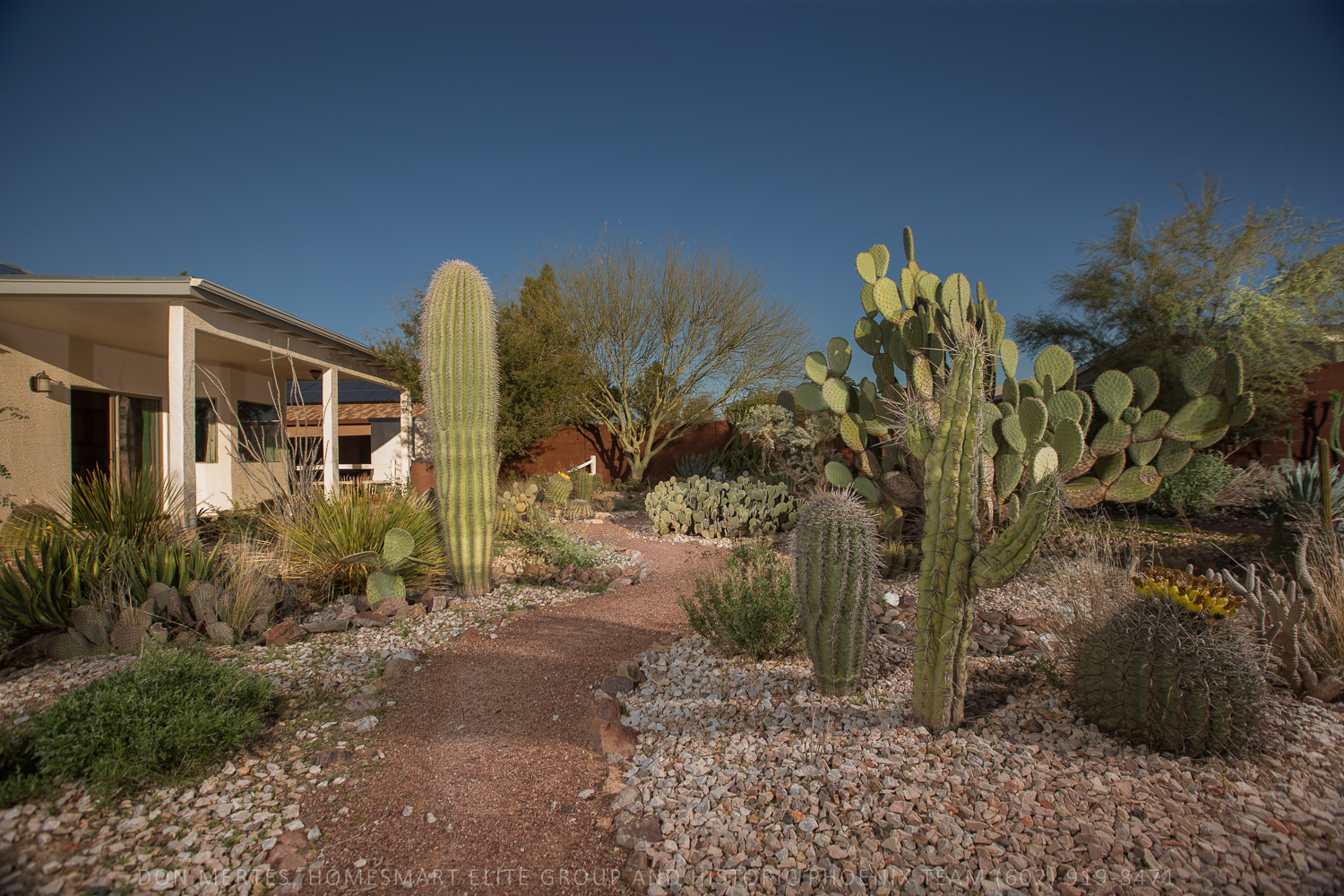
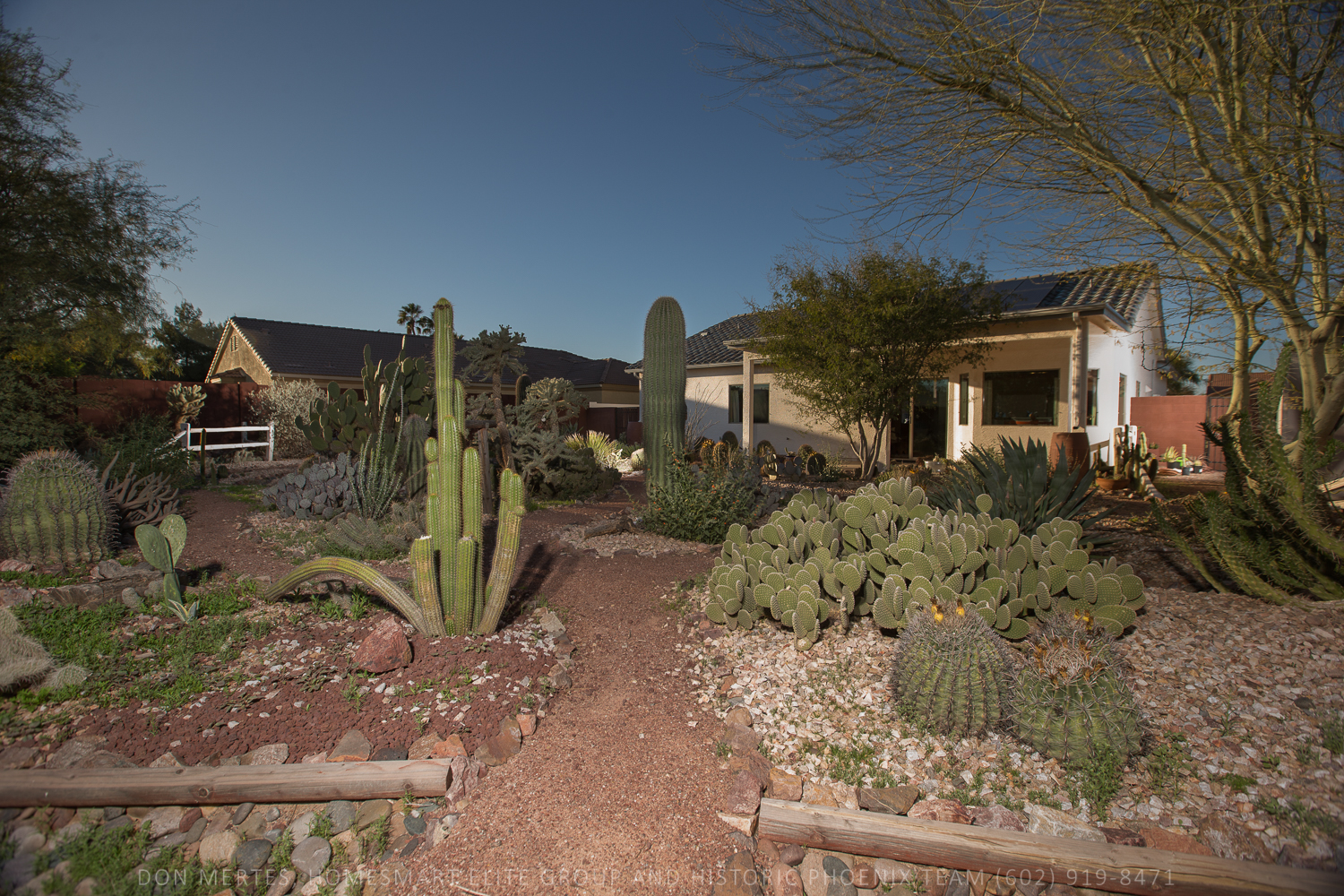
Together, they fashioned passive rain water harvesting systems that channel, capture and absorb rain, "banking" moisture in the soil for nearby plant roots to access over time. Their first step was to raise and level the backyard’s overall elevation by hauling in tons of dirt and decomposed granite, one wheelbarrow at a time. Gently sloped contours divert water away from the home and block fences, ultimately directing it into 130 feet of "Rivers" dug from the leveled landscape.
Bryan lined the rivers, which measures about 3 feet wide and 1 1/2 feet deep, with 5 tons of rock to reduce erosion. Resembling natural desert washes, the channels store rainwater safely away from the structures, allowing it to gradually permeate through the soil.
"Whenever it rains, we watch where water naturally moves or puddles and then tinker as needed to maximize the contouring and water flow," states Brian. Observing that the Rivers would fill up in the overflow during heavy rain storms, he incorporated PVC pipes strategically throughout the water harvesting system. "The pipes allow a mini waterfall effect, with water transferring one river to the next without flooding their banks," he explains.
Brian and Robin, who are avid hikers, replicate the pleasure of exploring the desert with their backyard’s ambling paths. "They have a balanced, but not symmetrical look, as if they're just trails worn from use," Robin describes.
Bryan's extensive plant collection lines the pathways. He estimates that 90% of the plants are cacti, supplemented with agaves, aloes and self-sowing wildflowers, such is Angelita Daisy, Blackfoot Daisy, Desert Bluebells, Desert Marigold, Globe Mallow and Poppies.
"I start many of the cacti from small cuttings or scruffy looking bits and cast-offs passed on from others," he explains. I love the challenge of bringing them to life, and it's fun to watch small starts develop into specimen plants." They also obtained modestly priced Saguaro and Barrel Cacti during volunteer salvage digs with the Tucson Cactus and Succulent Society.
Framing Plant Shapes
Rich paint color transforms the Bukovina’s backyard’s plain cinder-block wall into an effective backdrop for showcasing the couple’s plant collection. "We whitewashed benches and fences, and I wanted the wall paint to contrast with that," says Robin.
Although Ruby, the desert tortoise, has a secluded burrow on high ground behind the fence, she freely roams the backyard, foraging for wildflowers and cactus fruit. Robin chose this rich russet wall color as an effective backdrop for many shades of green displayed by desert plants. Bryan contoured the backyard channel rain water into shallow rock-lined “rivers” where it slowly percolates into the soil. Nearby plant roots, such as this trio of Thorn-crested Agaves, absorb the moisture.
"We find the desert to be inspirational," comments Robin. “The plants have such inner resources to persevere and bloom in demanding conditions. When out hiking or visiting Public Gardens, we take note of elements that catch our eye to re-create them in our garden."
For example, after noticing alone plant growing out of a rock formation in the wild, they positioned boulders in their landscape to re-create similar conditions. In nature, boulders provide mini micro-climates, such as rain collecting around their bases or heat radiating during cold weather. The couple also scatters wildflower seeds along their river washes in October to germinate as they do in nature with the arrival of winter rains.
Most of their plants are now well established and many have root systems along the washes to take advantage of the extra moisture. "We don't have drip irrigation, so, we aren't bothered with maintenance upkeep," comments Bryan. "If there is a hot dry summer stretch before the monsoons appear, I might fill up a river with the hose to give plants a deep soak if they look stressed. Otherwise, our landscape is really water-thrifty."
Wildlife Moves In
Dense with food and shelter plants, the couple’s backyard provides free-range stomping grounds for Ruby, a desert tortoise adopted from Arizona Sonora Desert Museum in Tucson.
"She's like a little tank trundling along the riverbank," laughs Robin. The couple sows native grasses and globe mallow wildflowers (Ruby's favorite) for grazing and she is a connoisseur of Prickly Pear fruit, preferring the flavor of some species to others. She's also handy to consult as a very accurate weather forecaster. "We always know when it's going to rain because Ruby returns to high ground in her habitat area," notes Robin.
The backyard is alive with scurrying lizards, as well as a steady stream of birds. The homeowners often see Cactus Wren, Curve-Billed Thrasher, Goldfinch and Gila Woodpecker, with some remaining to build nests. One season, seven birds nested in the relatively small backyard. Nests are often situated at eye level, including those designed by Cactus Wrens, with football-shaped constructions tucked amidst the spiky arms of Cholla Cacti.
"We've been asked to be on spring garden tours, but have declined so the birds aren't frightened from their nests by visitors taking photos of them," says Brian. Maybe when the plants grow a little taller."

/u.realgeeks.media/historicphoenix/end-video.jpg)